LLM
My new image compression algorithm achieves rates of up to 632:1
𝐭𝐥;𝐝𝐫 𝐥𝐥𝐦𝐏𝐄𝐆 𝐜𝐨𝐦𝐩𝐫𝐞𝐬𝐬𝐞𝐬 𝐢𝐦𝐚𝐠𝐞𝐬 𝐢𝐧𝐭𝐨 𝐥𝐚𝐧𝐠𝐮𝐚𝐠𝐞, 𝐧𝐨𝐭 𝐩𝐢𝐱𝐞𝐥𝐬. 𝐀 𝐯𝐢𝐬𝐢𝐨𝐧 𝐦𝐨𝐝𝐞𝐥 𝐭𝐮𝐫𝐧𝐬 𝐭𝐡𝐞 𝐢𝐦𝐚𝐠𝐞 𝐢𝐧𝐭𝐨 𝐚 𝐜𝐨𝐦𝐩𝐚𝐜𝐭 𝐉𝐒𝐎𝐍 𝐝𝐞𝐬𝐜𝐫𝐢𝐩𝐭𝐢𝐨𝐧.
This week, a meme made the rounds about a young prodigy inventing a new way to compress photos. The idea behind it: derive the content of the image with a multimodal #vision-language model, then store this instead of the image. And when you want to view it, an #image-generation model recreates the content.
Simple. 𝐀𝐧𝐝 𝐭𝐨𝐭𝐚𝐥𝐥𝐲 𝐋𝐎𝐒𝐒𝐘.
Running #JPEG with a quality setting 10 looks like archival preservation in comparison.
I saw the meme several times in my stream. Instead of laughing and getting back to work, I did the obvious thing: I built it.
Meet #llmPEG.
You get a tool for compression (driven by #Qwen-VL inside #ollama) and decompression (either #ComfyUI or the image-gen skill from #codex).
After the initial prototype was working, I did some refinement of the prompts with a GAN-ish style of loop: until we had – with the given metric – a sufficiently fitting reproduction.
Please don’t ask about wall-clock performance.
Compression: ~20 seconds.
Decompression: ~30 seconds.
But the compression rate! Always at least 100:1, if not better: check this page with examples: https://marcelpetrick.github.io/llmPEG/expanded.html
𝐀𝐭 𝐟𝐢𝐫𝐬𝐭 𝐢𝐭 𝐰𝐚𝐬 𝐚 𝐦𝐞𝐦𝐞, 𝐧𝐨𝐰 𝐢𝐭 𝐢𝐬 𝐚 𝐭𝐨𝐨𝐥 😉
Source code, if you want to run it yourself and/or contribute: https://github.com/marcelpetrick/llmPEG/
Video:
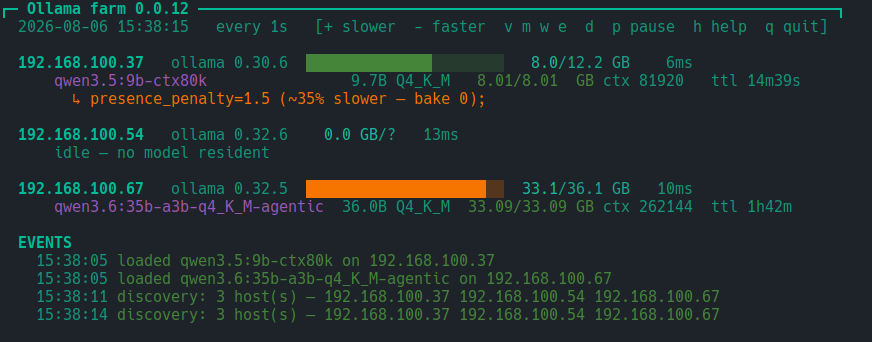
🦙 Release: 𝐎𝐥𝐥𝐚𝐦𝐚𝐅𝐚𝐫𝐦 ✨
Recently I had the need to monitor all the locally available #Ollama instances. Of course, you can 𝘤𝘶𝘳𝘭 yourself, but why not have a tool in the history of btop/abtop ..
Only one 𝘴𝘩𝘦𝘭𝘭 script utilizing 𝘤𝘶𝘳𝘭, 𝘢𝘸𝘬 and 𝘫𝘲. The name is the architecture: one llama is a pet, several across machines is a farm.
Tons of hotkeys to change update frequency, re-discovery of servers, probing their VRAM, cycling color themes. GitHub Actions ensure high quality code.
So give it a try and/or write a better version, #GPLv3 allows it: https://github.com/marcelpetrick/ollamaFarm/
Ollama Farmer out 🧑🏻🌾🦙
𝗜 𝗥𝗮𝗻 𝗮 𝟮𝟳𝗕 𝗠𝗼𝗱𝗲𝗹 𝗼𝗻 𝗮𝗻 𝟴𝗚𝗕 𝗚𝗣𝗨.
𝟰𝟬 𝗺𝗶𝗻𝘂𝘁𝗲𝘀. That’s all it took me to get Bonsai 27B running locally on an RTX A2000 Laptop GPU with just 8GB of VRAM.
Bonsai 27B is based on Qwen 3.6, but uses PrismML’s custom native 𝟏-𝐛𝐢𝐭 𝐁𝐨𝐧𝐬𝐚𝐢 format, reducing the model to just 3.9GB. A specialized 𝐥𝐥𝐚𝐦𝐚.𝐜𝐩𝐩 fork implements custom CUDA kernels for the 1-bit inference path, making it possible to run the model directly on an 8GB GPU. The runtime exposes an OpenAI-compatible API, so existing tools and agents work without modification.
Performance is a different topic: 15 down to 9 tokens/s.
If you want to give it a try: find my notes and setup-scripts at GitHub: https://github.com/marcelpetrick/codingWithGPT/tree/master/bonsaiTestrun
